A bright village. A world slowly going dark.A bright village.A world slowly going dark.
An HD-2D turn-based JRPG from an AI-native studio in Vietnam.
Pixel-art people and trees live inside a lit, three-dimensional village, where an East-Asian mountain hamlet and its Western neighbours meet a dark fantasy that creeps in at the edges.
Abandoned World Studio is a tiny independent studio in Vietnam, founded in October 2026, making HD-2D JRPGs at a quality that used to need large teams. We get there by putting Claude at the centre of production.
The thesis
01Where the cost is
Hand-drawn 2.5D games are expensive mainly in two places: art and iteration.
02What changes it
An AI-native pipeline: Claude agents plan, implement and review the work, and measured quality gates judge every step.
03What it unlocks
A two-person-scale team able to ship Octopath-class scenes.
FoundedOct 2026
Based inVietnam
FundingBootstrapped
TeamProducer-led
PlatformPC first
We are early, and we say so. What we can show is the process: an approved design, slices that only pass a gate with their numbers attached, and real frames from the engine.
Founder & producerTrường Thành Nguyễn LýHo Chi Minh City, VietnamLinkedIn ↗
IIStory
It begins in warm light.
Working design. The full story is written after the village demo; everything here can change.
Vân Khê16:30
Lâm · game sprite at
1The village
Vân Khê
A terraced rice village on a mountainside somewhere between East and West: tiled and thatched roofs, a stone bridge over a stream with a small waterfall, paper lanterns lit at dusk, a banyan on the square, bamboo and pines at the edge.
Western things have crept in over the years: a small stone chapel on the eastern edge, a graveyard with Western headstones behind a wrought-iron gate, a windmill on the slope. Lanterns, shrines and iron gates share one road.
2The hero
Lâm, a young farmer
Conical hat, brown cloth tunic, a woodcutter’s axe on his shoulder instead of a sword. He is nobody special yet.
The game begins with him walking home through the village on a golden afternoon.
3The seed of the dark
The priest who vanished
A generation ago a Western priest came and built the chapel. One winter he vanished, and nobody has gone up there since.
Lately the signs are back: bats the size of crows roosting on the forge roof, a whistling from the bell tower at night, the village drunk swearing he saw a figure standing on the tower. The notice board says it plainly: children stay off the stream bank after dark; nobody goes near the chapel after sunset.
4The turn
Bright, then dark
The story opens bright: rice about to flower, the tavern full, the blacksmith teasing Lâm about his chipped axe. Then it slides toward dark fantasy, with demons and curses and a world getting quieter.
The first time Lâm steps onto the chapel road at night, two or three blood-sucking bats come down on him, and the first battle begins.
People of Vân Khê
Six villagers, and the tavern regulars.
Tavern keeper
bà Hai
Runs the two-storey tavern and rents the room upstairs. Warns you off the chapel road at night.
Waiter
Lộc
Young, towel over one shoulder, proud of the fried tofu.
Village elder
cụ Lành
Walks with a stick, and remembers the priest.
Farmer
bác Tám
Stocky, never without his hoe, always asking for help cutting bamboo.
Blacksmith
bác Cường
Broad, in a leather apron. His grandfather forged the graveyard gate.
Seven years old
bé Su
Pigtails and hopscotch. Insists there is a ghost on the bell tower.
Tavern regulars: a travelling merchant; ông Sáu, who drinks too much and saw the shadow on the tower; and Tùng the woodcutter.
IIIPaths
Choose your path.
At a certain point in the story, the hero chooses one of three paths.
PlannedAfter the village demo. Pixel sprites are work in progress; hover a card to turn the figure faster.
Sprite in progress
DPS
Khí Kiếm Sư
Qi Sword Master
Channels inner force, qi, to control a flying sword that strikes enemies.
Sprite in progress
Tank
Thiết Thủ Sư
Iron Guard
Raises an iron shield to guard companions and cut the damage the party takes.
Sprite in progress
Summoner
Necromancer
Pours inner force into the ground to raise the corpses of enemies slain in the area and make them fight.
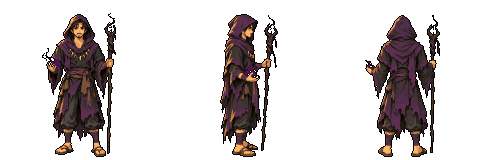
Game sprites at an integer scale, 144 px bodies on a 160 px cell: front, right profile and back, with the left profile mirrored as in the game.
IVThe look
Pixel art, lit like a real place.
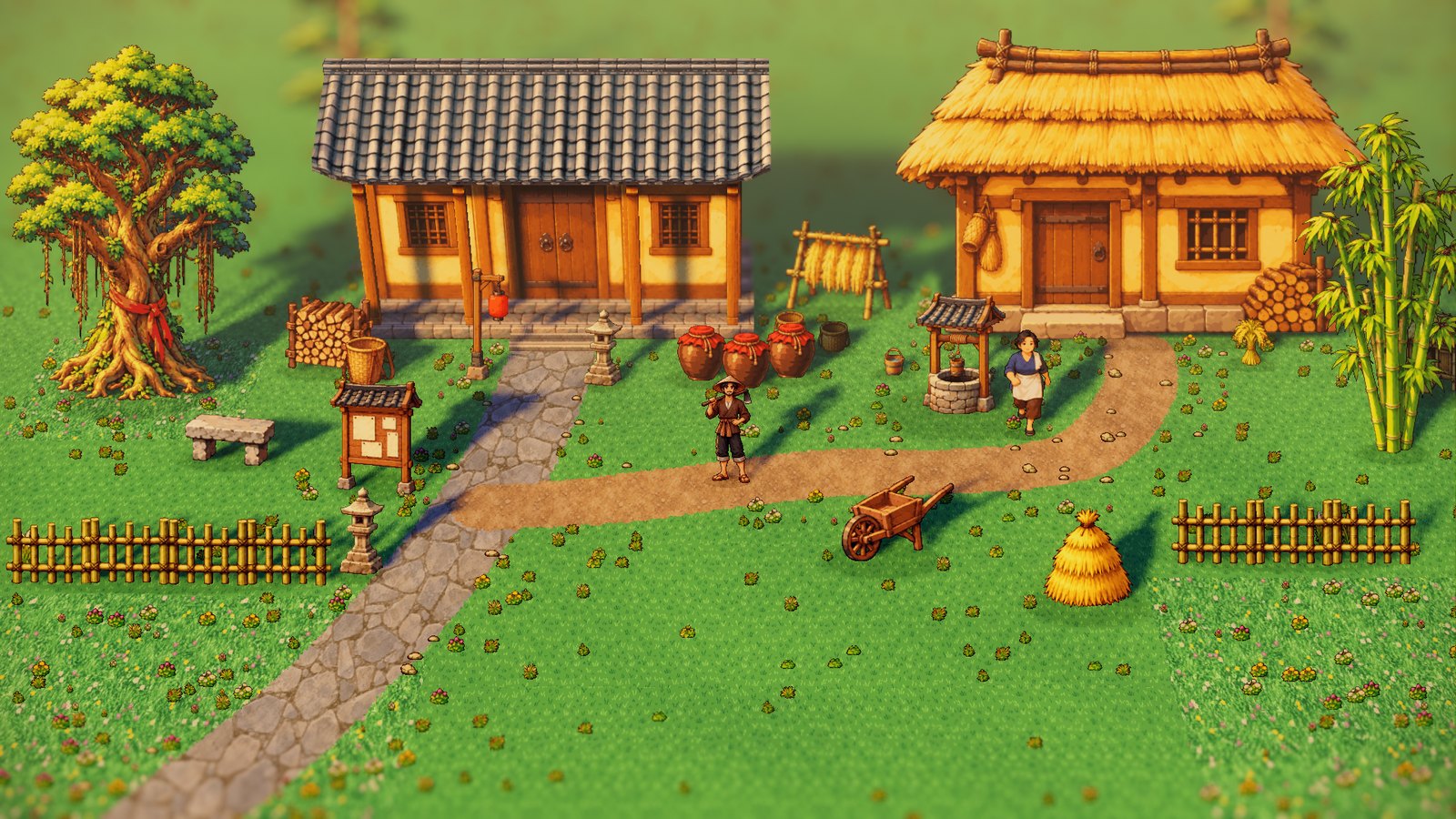
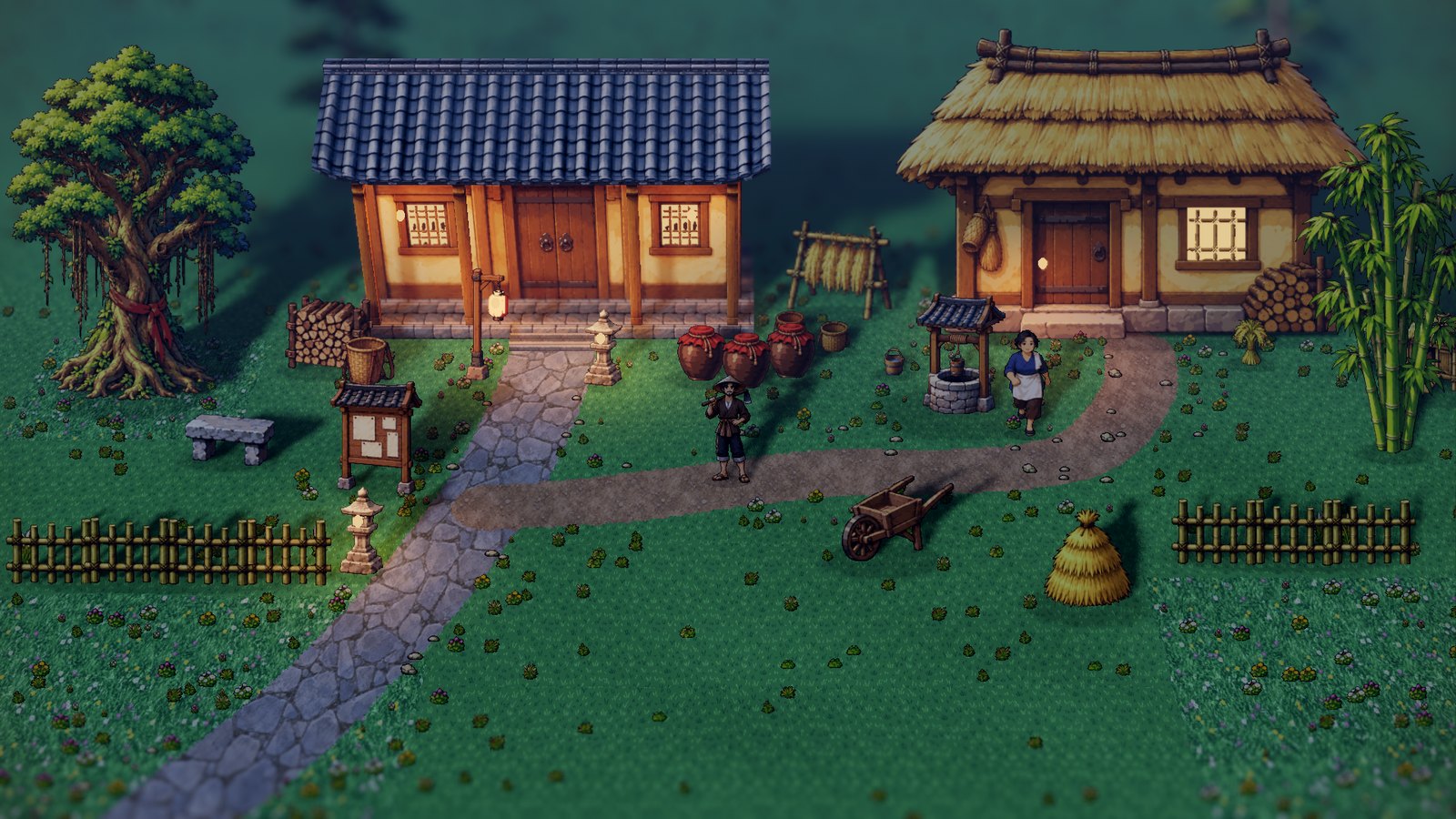
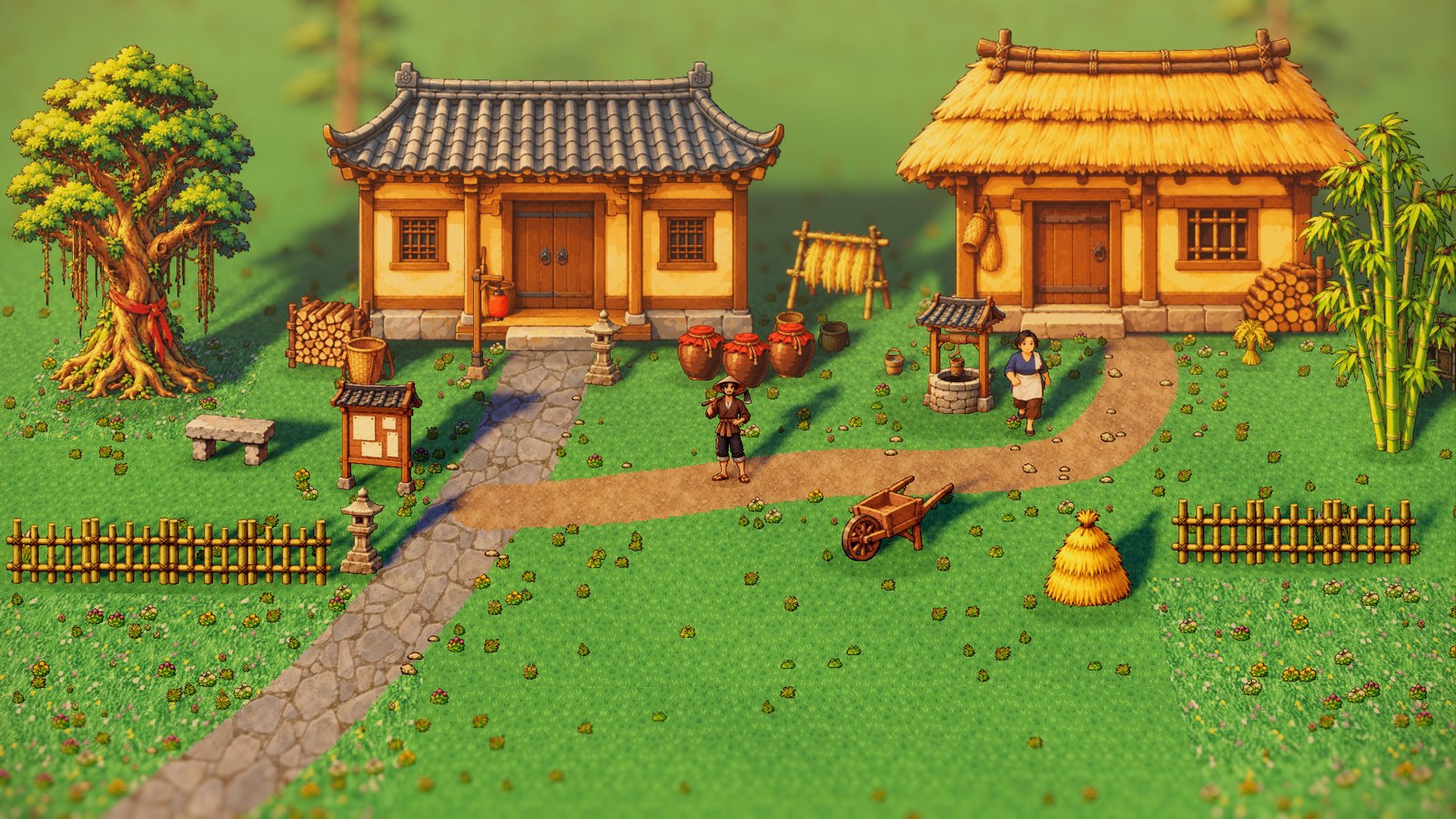
Hand-drawn pixel characters and foliage stand as cards in a real 3D scene. Large buildings are true 3D meshes wrapped in pixel textures, so sunlight, soft shadows and lamp light behave the way they do in the Octopath style, while the people stay crisp at one pixel per pixel.
Golden-hour sun
Soft shadows
Tilt-shift depth of field
Bloom
Lanterns and lit windows at night
One art pixel = one screen pixel
Mesh or card?
The same house at 16:30, built two ways. Drag the handle, or focus it and use the arrow keys.
3D meshFlat card
Engine capture
In motion. The hero crosses the corner at 16:30, captured from the engine for the Gate E review.
Frames from the build
All art is work in progress. Select a frame to view it full size.
VInitial design
What the village demo stands on.
The approved design pillars for the village demo.
Working designThe full story is written after the village demo; everything here can change.
Camera
Fixed three-quarter view
In the Octopath Traveler tradition: tilted about 35° with slight perspective, following the hero smoothly. Native 1920 × 1080 with one art pixel per screen pixel for people, now 144 px tall: sharp near the hero, tilt-shift blurred far away.
1 game day = 24 real minutes shown here 60× faster
Day and night
The sun turns with the hour
One game day is 24 real minutes. At night come lanterns, lit windows and fireflies, and bats circle the chapel after dark.
Hybrid stage
Real 3D, pixel skin
Terrain, water, mountains: real 3D with seamless pixel textures.
Large buildings: real 3D meshes wrapped in pixel textures, see-through when the hero walks behind them.
Trees, props, people: pixel cards standing in the scene.
Light: real engine light, soft shadows, fog, bloom and a full day–night cycle.
Initiative
LâmBatBat
Attackaxe
Defendhalf damage
Itemtwo healing potions
Runa chance
Battle
Turn-based, with an initiative bar
The first fight is a scripted night ambush on the chapel road. Lâm is a farmer, so the commands start deliberately few: Attack with the axe, Defend for half damage, Item with two healing potions, Run for a chance. Bats bite and drain. Win: experience and gold. Lose: you wake up at the tavern with 1 HP.
Break and weakness systems, a full party and gear come later.
The village as hub
A village worth walking through
Hero’s house
Two-storey tavern
Inn room
Forge
Abandoned chapel
Graveyard
Thatched and tiled houses
Well
Bridge
Paddies
Stream and waterfall
Bamboo and pines
Windmill
The tavern can be entered: the owner, the waiter and guests eating and drinking downstairs, stairs up to an inn room where you sleep until morning. The village is now being rebuilt as a dense core of two rows of houses around the well square.
bà Hai
Villagers
Schedules and a classic dialogue box
Villagers keep daily schedules and say different things by day and by night, in a classic JRPG dialogue box. The game text is Vietnamese, with one or two choices when it matters.
Companions Planned
Friends met on the road
While exploring the world, the player can recruit companions met on the road. They join the party and fight alongside the hero. Party, gear and the Break and weakness systems come after the demo.
Tech and process
Typed, data-driven, tested
Godot 4.7.2
Statically typed GDScript
Every number in JSON data
Headless test suite
Golden-frame image tests
60 fps at 1080p, PC target
PC first, phone later
In-game language: Vietnamese
VIPlanned features
What comes after the demo.
Everything on this list is planned for after the village demo. These are plans, written as plans: no dates, and the scope can change.
Planned
Equipment
Weapons, armour and charms that change how the hero and companions fight and look.
Planned
Build your home
Rebuild and furnish a house in Vân Khê; it grows with the story.
Planned
Farming
Tend rice paddies and a vegetable garden; crops follow the day–night clock and the seasons.
Planned
Pets
Raise animals and creatures met on the road; they follow you and help in small ways.
Planned
Companions
Recruit allies found while exploring; each has their own path.
A producer sets the design and signs off every gate. In between, Claude Code and multi-agent workflows run the production: Claude agents plan each slice, implement it in Godot, review each other’s work and only hand over results that pass automated tests and measured quality gates.
TodayClaude runs the production
Speca written design the producer approves
Task planexplicit tests for every task
Implementan implementer agent writes the code
Reviewan independent reviewer agent, fix rounds
Slice reviewthe whole slice, end to end
Gatemeasured numbers, producer sign-off
Specs, plans and agent pairs
Every slice starts as a written design, becomes a task plan with explicit tests, then runs as a pipeline: an implementer agent, an independent reviewer, fix rounds, and a slice review before anything reaches the producer.
Gates with numbers
Look, performance and layout are judged against measured targets: frame-to-frame shimmer, lighting continuity across the screen, village density per camera frame, frames per second on the target renderer. A gate opens only with the numbers attached.
Art pipeline and asset contracts
Concept sheets from image models are cut, scaled to a fixed ruler and pixelised to a locked palette by scripts, then checked against an asset contract before they enter the game. People, buildings, textures and props each have their own route.
tasks executed by agents under review
40+
automated tests across engine and pipeline
380+
pixel scale for people at 1080p, by design
1:1
Forward+ renderer on the target PC profile
60 fps+
NextClaude in the game and the tools
Villagers in character
Villager dialogue generated and kept in character by Claude.
Quests and the notice board
Quest and notice-board text written with Claude.
Localisation
Localisation of the Vietnamese script.
Playtest reports
Agent-run playtests that report back what they find.
Lâm’s walk cycle, straight from the game’s sprite sheet: four frames at 5 fps, shown at 1:1.
VIIIRoadmap
From one corner to a whole village.
The village demo is built in slices. Each slice ends at a gate the producer signs off, and a gate opens only with the numbers attached.
Slice 0DoneGate 0
Tech proof
An empty 3D stage with one cutout house and a walking hero: the fixed 35° camera, depth of field, glow and fog, a sun that turns with the hour, the one-art-pixel-per-screen-pixel rule, a headless test suite and automatic clip capture.
Slice 0.5DoneGate D
Look development
One fully dressed village corner on a single screen: golden-hour sun, soft shadows, painted ground and stone paths, dense props and flowers, tilt-shift and bloom, night with lanterns. The producer locked the look at Gate D.
Slice 0.6DoneGate E
3D buildings and bigger people
Large buildings rebuilt as real 3D meshes wrapped in pixel textures drawn from orthographic elevations; people resized to 144 px. At Gate E the producer compared mesh and card side by side and chose real 3D buildings.
Slice 1NowGate 1a passed · Gate 1 next
The whole village
Full terrain with paddies, pond, stream, waterfall and bridge; a walkable grid and camera follow; a dense core of two rows of houses around the well square, 14+ structures, chapel and graveyard, windmill; villagers standing and walking their routes, chimney smoke, wind in the bamboo and laundry, night; a 20-second walkthrough. Gate 1a covers the north half, then Gate 1 is the main quality gate. Gate 1a (the north half in real art) passed on 8 October and slice 1b (the south row, villagers, night life and wind) followed; the map edges, a closer camera and weather are now in, and work from later slices (house interiors, villagers at work, the first boss fight) has started early.
Slice 2PlannedGate 2
Village life
Daily schedules for nine villagers, the dialogue system and notice board, the two-storey tavern interior with guests eating and drinking, stairs to the inn room, sleeping until morning.
Slice 3PlannedGate 3
The bat battle
The scripted night ambush on the chapel road: the turn-based battle scene and UI, the initiative bar, win, lose and run.
Slice 4PlannedGate 4
Packaging
Tuning, a PC performance pass, the Windows build and documentation. A phone build follows in a later pass.
Beyond the demoPlanned
The world past Vân Khê
The full story and new areas beyond the village; the choice of three paths; companions met on the road who join the party; gear, Break and weakness systems; random encounters; villagers whose dialogue is generated with Claude; saving; localisation.
IXDev log
Building in the open.
Short, true milestones, newest first.
The dream (Mộng Cảnh) now has its third part and runs 3 min 11 s. In the teaching duel, the stranger opens his Taoist domain, Thái Cực Lưỡng Nghi, and the right half of the moonlit lake turns into an ink-and-jade Taiji. He then guides Lâm to open his own. Lâm draws 19 lines of light across the water and the lake becomes a Go board. The two domains clash at the halfway line, and the remaining rounds are fought inside both. Every Kỳ Sĩ technique now hits with weight: a wind-up, a flash, a short hit-stop, a camera kick and shake, stone chips and dust, and its own stone sounds. Four techniques are new: Trấn Thần Đầu, Chinh Tử, Bế Mục Lạc Tử and the finisher Thu Quan, which can end a fight early. The checks for every changed part pass. Next: the opening cutscene in the chapel.
The hero gets his first class, Kỳ Sĩ Dị Thuật: a Go master who fights with a board held in one hand and a pouch of black and white stones. Black stones dropped or fired around an enemy fill its four liberties; once it is surrounded, Ăn Quân picks the stones up and crushes them for a heavy blow that stuns it, while white stones form eyes that shield an ally. The night fight now has real sound — 68 effects made for the game and a boss theme, mixed under a limiter. After the stranger’s pressure-point strike the hero wakes inside a dream: six sepia paintings show the village of Vân Khê burned by vampires if he falls tonight, the water splits into three paths, he walks the Go master’s path, awakens the class and spars with the stranger in a teaching match. A round of fixes followed: the basic stone flick flies straight with a wind-tear trail, hit flashes and liberty markers are cleaner, and the two-minute chapel fight was polished in both sound and picture. 226 battle checks green. Next: both of them opening their domains inside the dream, and harder-hitting Go techniques.
The golden bell now drops from the sky over the kneeling hero with a frosted glass belly and sutras scrolling down inside it, cracks slowly in three beats while the bat keeps striking, and only then shatters. The mysterious stranger got his first move, Phật Ảnh Bách Quyền: he forms a Buddhist mudra, a huge golden Buddha shadow rises behind him and rains thirteen punches on the demon bat, the last one so heavy that the screen cracks and shakes. He no longer simply appears either: two slashes tear the air open and he steps out of the dark rift. After the barrage the bat reels, stunned, with stars circling its head; the stranger blinks behind the hero, touches a pressure point on his neck, and the hero falls into a dream. A design for real sound was approved: effects first, with quiet music underneath. 206 battle checks green. Next: what the stranger wants from the hero in that dream.
Two battle domains: when the demon bat drops below half health it pulls the fight into its Blood Moon domain — a close-up cut-in, a five-second video, then a blood-red chapel that drains the hero every turn. At the last moment a golden temple bell drops over the kneeling hero, and a mysterious stranger walks down through the air on three invisible steps, each one sending a shockwave across the arena, then splits the arena in half with his own Buddhist domain, the Old Temple of the Great Bell, which shields, cleanses and heals his side. Allies now stand in a staggered line of up to four, the command menu has become a tilted 3D Bagua compass whose needle swings to each option, and the golden bell is being redrawn with a translucent glass belly. 191 battle and UI checks green. Next: a bell that cracks slowly before it shatters.
Fights move onto a real stage: they now play out in a 2.5D night chapel painted as one picture and projected onto simple 3D blocks, with moonbeams full of slow dust, flickering candles and a camera that matches the painting. The vampire lord Ngọc Diện Huyết Quân enters the fight with three cinematic moves — a claw rake with afterimages, a bite where he bursts into bats, and a leap that forms a blood spear out of thin air — and heals a little from every hit; beaten, he collapses and rises again as the demon bat Huyết Dạ Bức Vương, who swoops, shrieks in rings of sound and crumbles to ash when defeated. New 3D effects (particles that bounce on the real floor, glowing shapes, moving lights that relight the painted stage, heat haze), the first battle UI drawn as calligraphy scrolls, and the hero now runs when you hold Shift.
The test arena becomes a real fight: the training dummy strikes back, and the hero can raise his guard behind a shield aura to halve the damage, drink a potion, get knocked out or win, hopping back to his place after every swing. The first boss takes shape too: Ngọc Diện Huyết Quân, a vampire lord who mixes East and West, with a jade-pinned topknot, a crimson silk robe and a black cape cut like bat wings. His eight battle moves — breathing idle, gliding in and out, claw, draining bite, blood magic, hurt and transformation — are eight frames each, and in every frame the cape and coat tails trail, overshoot and settle like heavy cloth; a cutscene shows him attacking the tavern waiter. His second form, the huge demon bat Huyết Dạ Bức Vương, has nine eight-frame moves drawn (hover, emerge, wing strike, dive, shriek, summon a swarm, draining bite, hurt and a death that crumbles to ash), along with blood, shriek and bat-swarm effects. All game text now uses Cormorant Garamond. 895 automated checks green. Next: the fight against Ngọc Diện Huyết Quân in the test arena.
The first fights: in a small turn-based test arena the hero swings his woodcutter’s axe at a training dummy, with a slash trail, sparks, wood chips, a short screen shake and floating damage numbers. Nine battle animations are drawn for him — battle stance, raising and holding his guard, blocking, getting hit, falling, drinking a potion and celebrating — with matching hit, guard and healing effects. Upstairs at the inn, guests now sit cross-legged on floor cushions and lean on the balcony rail while the waiter kneels to pour tea. 869 automated checks green.
Visitors and animals arrive: a travelling merchant now drives his horse-drawn cart in through the east gate every few days, parks by the well square and spends the evening at the tavern, while two flocks of chickens and two dogs keep their own hours — roosting at night, crowing at dawn, pecking around the yards, dozing in the sun and running for cover when it rains. Indoors, the chapel is rebuilt to scale with an entrance hall, a chancel arch and a semicircular apse, and it finally looks abandoned, with broken, overturned and scattered pews; the tavern is redone in a Vietnamese style with a small inn upstairs, a closed kitchen curtain, a matching set of tables, benches and stools, and guests seated on the benches behind their tables. Roofs that hide the hero now turn truly see-through, two tavern guests got faces of their own, clutter was cleared off the village paths and three silkworm-tray corners were added. 807 automated checks green. Next: re-locking the reference frames at the new camera.
One timetable for the whole village: in the evening the tavern fills up and the waiter serves the guests at their tables. Light indoors now follows the clock — morning sun through the windows, lanterns and oil lamps from five in the evening, moonlight at night — and the tavern lost its orange cast. A travelling merchant with a horse-drawn cart has been drawn, driving toward the camera and away down the road, ready to visit the village; the potter at his wheel, the village elder and the waiter were redrawn, and three new tavern guests were added. Two interior redesigns were approved: a longer chapel (12 × 26 m) with an entrance hall, a chancel arch and a semicircular apse, and a Vietnamese-style tavern with a small inn upstairs. 707 automated checks green. Next: the merchant’s visits, the rebuilt chapel and the new tavern.
The village keeps its own hours: all ten villagers now follow a 24-hour routine, walking real paths between their work, their doorsteps, the well and the benches, sitting down and getting up again, chatting by the well, going indoors at night, turning to look when the hero comes close and running for the nearest shelter when the rain sets in. Fourteen newly drawn sheets give them work to do: the smith hammers at the anvil, the woodcutter chops firewood, the farmer hoes and plants in the paddies, the potter throws pots at the wheel, the vegetable seller lays out the stall, the innkeeper pours at the counter and the tavern guests sip their drinks. The hero can sit on any free bench too. 648 automated checks green. Next: one timetable for the whole village, with guests filling the tavern in the evening.
Doors open: the hero can now walk into the two-storey tavern and the old chapel. A short fade carries you through the door or up the stairs in about a second while the clock keeps running outside, and the paper windows take on the colour of the sky. The tavern is fully drawn, from the long counter and the seventeen-step staircase to the folding screen and the guest bed upstairs, with guests at their tables, the innkeeper behind the counter and a waiter making the rounds. The chapel has a cracked stone floor, worn pews, columns and arches, candles on the altar, cobwebs and rubble, and three stained-glass windows that glow with the hour.
The villagers learn to move: all eleven village characters now walk and run in every direction (six frames each), sit down, sit and talk with four different gestures, drawn as 33 new sheets and cut to the game’s 144 px pixel frames; the tavern customer is a brand-new character. Entering the village went from about 11 seconds to about 1.2 after a slow ground-painting step was rewritten and cached, and the near depth of field of the new camera was tuned so the ground the hero walks on never blurs. 546 automated checks green. Next: daily routines, with villagers walking real paths, sitting on benches and running for shelter when it rains.
Weather arrives in the village: daytime rain with mist, wet ground, splashes and rings on the water, and night thunderstorms where the rain catches the warm light of lanterns and windows and the lightning lights the whole square (with a setting to soften or turn off the flashes). The stairs between the paddy terraces are now small rounded stones set into the earth path, the stair down to the southern lake is built of long thick stone slabs between rock cheeks, and the graveyard behind the chapel is closed by a real 3D iron fence. 529 automated checks green. Next: the insides of the tavern and the chapel.
Five pieces of work joined the main build tonight: softer house faces at dawn and dusk, drifting moonlit cloud shadows at night and a lantern at the tea stall; a natural cliff on the southern edge dropping into a lotus lake; houses and big trees that fade out as a whole when they hide the hero; warmer, greener northern cliffs with a low mossy bank around the pond; and real ground — olive grass, faded patches, bare earth and worn footpaths where people actually walk.
A closer camera: after comparing three heights at eight spots in the village, the play camera moves in to look down at 25°, with the hero 216 px tall on a 1080p screen, for a warmer, closer HD-2D frame. Houses, stall roofs and big trees will fade out as a whole when they stand between you and the hero, instead of opening a round hole. Weather is on the way too: daytime rain with wet ground, splashes and ripples on the water, and night thunderstorms whose lightning lights up the whole village, with a setting to soften or turn off the flashes.
Map edges, take two: the north cliff is rebuilt as one continuous, mossy rock face with outcrops standing out from it, and the village waterfall now drops from a cleft at the top into a pond at its foot (364 automated checks green). The east river, fed by small falls in the north-east, and a two-arch stone bridge at the end of the east road are built and being merged in. Every edge of the map keeps a way through to the next one: a pass, a path or a bridge.
The paddy terraces are rebuilt: packed-earth banks with rounded, overhanging grass lips, stone steps where the path climbs between levels, and stones at the foot of each bank. The tea stall, both market stalls, the storage shed and the watch hut now stand in the village as real 3D buildings with their wares laid out. All 337 automated checks are green.
Repair and polish day: the weekend changes are back under the full test suite (323 checks green) and the stream now runs between curved, pebble-lined banks instead of square steps. The tea stall, market stalls, storage shed and watch hut get real 3D models built from new front and side elevations, the paddy terraces are being rebuilt as packed-earth banks with grassy lips and stone steps from a painted concept, and the map edge art is cut: cliff faces and outcrops, a landslide that closes the east road, a small cascade into the southern lake, lotus and a sampan, and layered mountain and forest backdrops.
Rice now grows in planted rows over a muddy paddy, the houses get real wooden and plaster side walls, the paddy terraces get earth banks, and the stream gets deeper water colours, a gravel bed and mossy stones. The map border is designed: cliffs to the north and west, a river to the east and a cliff over a lake to the south.
The village grows denser: seven more homes, a small market with two striped stalls, a back street and a lane through the paddies, and four new villagers: a woodcutter, an old neighbour and two stall keepers.
Performance pass: the village now loads in under two seconds, a ground-aware cull trims the shadow casters, and every frame budget holds at 1080p (about 180 fps on the target PC). Art for the next steps is drawn ahead: mountain backdrops, cliffs, lake and river props, a forest wall, new side walls for the houses and a pixel UI kit for dialogue and battle.
A new roof for the hero's house: a shorter eave so the door is never hidden from the play camera, deeper upturned corners and a less repetitive tile texture. The forge smoke now rises from its drawn flue.
The whole village now runs on real art, shown by two guided demos: a day-to-night tour in ten chapters, from 05:30 to 23:00 with bats circling the chapel tower at night, and a one-minute walk through the village. Seven reference frames of the village are locked for regression tests; 293 automated tests green.
Wind reaches the village: trees, bamboo, rice, reeds, laundry and the festival banner sway with gusts that follow the time of day, each plant on its own phase, while the 3D houses stay still. The waterfall spray now runs on the game clock so every capture repeats exactly.
Night comes alive: lamps and windows light on each house's own hours, chimney smoke, fireflies and bats over the chapel tower; villagers no longer turn black in moonlit shade. Five villagers drawn as 144 px pixel sprites (the child at 101 px), and the yard props, bamboo, areca and longan trees are in.
Slice 1b under way: the south row (a thatched house, a tiled house, an open-front forge whose furnace and fire stay in view, and the village gate) rebuilt in 3D from the drawn elevations, and six villagers placed, two of them walking their rounds.
Gate 1a passed: the north half of the village in real art (the well square, the two-storey tavern, the chapel and graveyard, the waterfall and the terraced paddies), with 245 automated tests green and 18 known issues measured and queued.
Ten more concept sheets for slice 1b: two bamboo clumps, six yard props, two village trees and the walk cycles of five villagers.
Slice 1 begins: the whole village. A dense core of houses around the well square, terrain with paddies and a stream, 13 new concept and elevation sheets drawn in a day.
Gate E: real 3D buildings with pixel textures and 144 px people approved by the producer.
3D hero house with a pixel-texture atlas, and 144 px people. Gate E package prepared.
Gate D: the look is locked. Golden hour, soft shadows, depth of field, bloom.
Look-development slice with the first dressed village corner.
Abandoned World Studio is an independent, AI-native game studio based in Vietnam. We are early, building in the open and happy to talk to publishers, partners and people who love this genre.